
Follow Carter Nursing and Rehabilitation on Facebook! Click Here

To see a list of frequently asked questions please Click Here

Carter | Nursing & Rehabilitation

Latest News

Latest News

Caring for Yourself When Caring for Another

May 9, 2023

You are a caregiver if you care for someone who needs help. Caregiving can be hard on you despite the great sense of reward you may feel. To continue being a good caregiver, you need to take care of yourself. One way you can do that is to make sure you have consistent breaks from your caregiving responsibilities. This is called respite. Short breaks can be a key part of maintaining your own health.

WHAT IS RESPITE CARE?

You are a caregiver if you are caring for someone who needs help. Taking short breaks can be the key to maintaining your own health.

Respite care allows the caregiver some time off from their caregiving responsibilities. It can take the form of different types of services in the home, adult day care, or even short-term nursing home care so caregivers can have a break or even go on vacation. Research shows that even a few hours of respite a week can improve a caregiver’s well-being.1 Respite care may be provided by family, friends, a nonprofit group, or government agency. Some of these services may be free or low-cost.

FAMILY AND FRIENDS

Make Your Needs Known

Here are some suggestions for getting help from people you know.

  1. Identify a caregiving task or a block of time that you would like help with. Perhaps there’s a book club meeting you’d like to go to that you’ve been missing because of your caregiving responsibilities. Be ready when someone says, “What can I do to help?” with a specific time or task, such as, “It would be really helpful for me if you could stay with Mom Tuesday night so I can go to my book club for 2 hours.”
  2. Be understanding if you are turned down. The person may not be able to help with that specific request, but they may be able to help another time. Don’t be afraid to ask again.
  3. If you have trouble asking for help face to face, try writing an e-mail to your friends and family members about your needs. Set up a shared online calendar or scheduling tool where people can sign up to provide you with regular respite.

YOUR DOCTOR OR OTHER HEALTH CARE PROVIDER

Does your doctor know you are a caregiver?

  • You have special needs as a caregiver that your doctor should be aware of. Be sure to let your doctor know if your caregiving responsibilities are making you feel depressed or anxious. Health care professionals may also know about support groups offered in the community.
  • Let your doctor (or your care recipient’s doctor) know that you need help finding respite care. A doctor may be able to write you a “prescription” for respite services via Medicare’s PACE program. PACE services are available to Medicare and Medicaid beneficiaries in some states.

NONPROFIT ORGANIZATIONS OR GOVERNMENT AGENCIES

Here’s how to get back some of your “me time”

A great source for respite services is the Area Agencies on Aging. Check the website for the agency in your area. Other resources include:

  • Organizations that advocate for people with specific diseases. If you care for someone with Alzheimer’s disease, heart disease, cancer, or lung disease, respite care services may be available from the following organizations.

The Department of Veterans Affairs offers respite resources for veterans or their spouses.

STILL NOT ABLE TO GET A BREAK?

Consider joining an online support group. It’s important for you to have an opportunity to share your experiences with others in similar circumstances and to get support and new resources from them.

  • Family Alliance on Caregiving—The Caregiver-online support group is an unmoderated group for families, partners, and other caregivers of adults with disorders such as Alzheimer’s, stroke, brain injury, and other chronic debilitating health conditions. The group offers a safe place to discuss the stresses, challenges, and rewards of providing care for another.
  • Caring.com Resource Center—Offers key resources to help you better navigate caregiving and access to online support groups, such as the Alzheimer’s Caregiver Support Group.

Remember—To be an effective caregiver, you must take care of yourself. Your care recipient is counting on you.

To learn more, please visit https://www.cdc.gov/aging/publications/features/caring-for-yourself.html.
Nurses Week 2023: Discounts and Freebies All Month Long!

May 8, 2023

We are preparing for an amazing celebration of National Nurses Week this year! Many companies are showing their gratitude for nurses and healthcare workers by offering awesome deals and freebies during Nurses Week and throughout the year. Whether you are a healthcare worker looking for a good deal or you’re shopping for a healthcare hero in your life, check out these great deals valid for the entire month of May for Nurses Week 2023!

Food & Grocery

Electronics

  • Bose – Special discount on orders over $199
  • Samsung – 30% off
  • HP – Savings up to 40% off & free shipping
  • McAfee – Special discount on 10-Device McAfee Total Protection for Nurses
  • Therabody – 20% off regularly-priced Theragun or TheraOne CBD for Nurses
  • Sennheiser – Up to 20% off & free shipping for Nurses
  • Netgear – 15% off
  • Leatherman – 30% off multi-tools
  • Ember – 20% off
  • Sonos – 15% off
  • Lenovo – 5% off

Apparel, Shoes, & Accessories

Entertainment & Services

Cosmetics, Skincare, & Nutrition

Outdoors, Sports, & Fitness

In addition to this month’s discounts and freebies, we are proud to partner with Panda Perks to give our Care Team members 24/7 access to discounts and perks on the brands you love!

Implementation of Personal Protective Equipment (PPE) Use in Nursing Homes to Prevent Spread of Multidrug-resistant Organisms (MDROs)

April 25, 2023

Background

Residents in nursing homes are at increased risk of becoming colonized and developing infection with MDROs [2]. As described further in Consideration for the Use of Enhanced Barrier Precautions in Skilled Nursing Facilities [PDF – 9 pages], more than 50% of nursing home residents may be colonized with an MDRO, nursing homes have been the setting for MDRO outbreaks, and when these MDROs result in resident infections, limited treatment options are available [1-9]. Implementation of Contact Precautions, as described in the CDC Guideline for Isolation Precautions, is perceived to create challenges for nursing homes trying to balance the use of PPE and room restriction to prevent MDRO transmission with residents’ quality of life. Thus, many nursing homes only implement Contact Precautions when residents are infected with an MDRO and on treatment.

Focusing only on residents with active infection fails to address the continued risk of transmission from residents with MDRO colonization, who by definition have no symptoms of illness. MDRO colonization may persist for long periods of time (e.g., months) [10] which contributes to the silent spread of MDROs.

With the need for an effective response to the detection of serious antibiotic resistance threats, there is growing evidence that the traditional implementation of Contact Precautions in nursing homes is not implementable for most residents for prevention of MDRO transmission.

This document is intended to provide guidance for PPE use and room restriction in nursing homes for preventing transmission of MDROs, including as part of a public health response. For the purposes of this guidance, the MDROs for which the use of EBP applies are based on local epidemiology. At a minimum, they should include resistant organisms targeted by CDC but can also include other epidemiologically important MDROs [9, 10].

Examples of MDROs Targeted by CDC include:

  • Pan-resistant organisms,
  • Carbapenemase-producing carbapenem-resistant Enterobacterales,
  • Carbapenemase-producing carbapenem-resistant Pseudomonas spp.,
  • Carbapenemase-producing carbapenem-resistant  Acinetobacter baumannii, and
  • Candida auris

Additional epidemiologically important MDROs may include, but are not limited to:

  • Methicillin-resistant Staphylococcus aureus (MRSA),
  • ESBL-producing Enterobacterales,
  • Vancomycin-resistant Enterococci (VRE),
  • Multidrug-resistant Pseudomonas aeruginosa,
  • Drug-resistant Streptococcus pneumoniae

This document is not intended for use in acute care or long-term acute care hospitals and does not replace existing guidance regarding use of Contact Precautions for other pathogens (e.g., Clostridioides difficile, norovirus) in nursing homes.

Description of Precautions

Standard Precautions are a group of infection prevention practices that apply to the care of all residents, regardless of suspected or confirmed infection or colonization status. They are based on the principle that all blood, body fluids, secretions, and excretions (except sweat) may contain transmissible infectious agents. Proper selection and use of PPE, such as gowns and gloves, is one component of Standard Precautions, along with hand hygiene, safe injection practices, respiratory hygiene and cough etiquette, environmental cleaning and disinfection, and reprocessing of reusable medical equipment. Use of PPE is based on the staff interaction with residents and the potential for exposure to blood, body fluids, or pathogens (e.g., gloves are worn when contact with blood, body fluids, mucous membranes, non-intact skin, or potentially contaminated surfaces or equipment are anticipated). More detail about Standard Precautions is available as part of the Core Infection Prevention and Control Practices for Safe Healthcare Delivery in all Settings.

Contact Precautions are one type of Transmission-Based Precaution that are used when pathogen transmission is not completely interrupted by Standard Precautions alone. Contact Precautions are intended to prevent transmission of infectious agents, like MDROs, that are spread by direct or indirect contact with the resident or the resident’s environment.

Contact Precautions require the use of gown and gloves on every entry into a resident’s room. The resident is given dedicated equipment (e.g., stethoscope and blood pressure cuff) and is placed into a private room. When private rooms are not available, some residents (e.g., residents with the same pathogen) may be cohorted, or grouped together. Residents on Contact Precautions should be restricted to their rooms except for medically necessary care and restricted from participation in group activities.

Because Contact Precautions require room restriction, they are generally intended to be time limited and, when implemented, should include a plan for discontinuation or de-escalation.

More detail about Transmission-Based Precautions, including descriptions of Droplet Precautions and Airborne Precautions are available in the CDC Guideline for Isolation Precautions. In addition, other infections (e.g. norovirus, C. difficile, and scabies) and conditions for which Contact Precautions are indicated are summarized in Appendix A – Type and Duration of Precautions Recommended for Selected Infections and Conditions of the guideline.

Enhanced Barrier Precautions expand the use of PPE and refer to the use of gown and gloves during high-contact resident care activities that provide opportunities for transfer of MDROs to staff hands and clothing [11-15]. MDROs may be indirectly transferred from resident-to-resident during these high-contact care activities. Nursing home residents with wounds and indwelling medical devices are at especially high risk of both acquisition of and colonization with MDROs [3,5,6]. The use of gown and gloves for high-contact resident care activities is indicated, when Contact Precautions do not otherwise apply, for nursing home residents with wounds and/or indwelling medical devices regardless of MDRO colonization as well as for residents with MDRO infection or colonization.

Examples of high-contact resident care activities requiring gown and glove use for Enhanced Barrier Precautions include:

  • Dressing
  • Bathing/showering
  • Transferring
  • Providing hygiene
  • Changing linens
  • Changing briefs or assisting with toileting
  • Device care or use: central line, urinary catheter, feeding tube, tracheostomy/ventilator
  • Wound care: any skin opening requiring a dressing

In general, gown and gloves would not be required for resident care activities other than those listed above, unless otherwise necessary for adherence to Standard Precautions. Residents are not restricted to their rooms or limited from participation in group activities. Because Enhanced Barrier Precautions do not impose the same activity and room placement restrictions as Contact Precautions, they are intended to be in place for the duration of a resident’s stay in the facility or until resolution of the wound or discontinuation of the indwelling medical device that placed them at higher risk.

Implementation

When implementing Contact Precautions or Enhanced Barrier Precautions, it is critical to ensure that staff have awareness of the facility’s expectations about hand hygiene and gown/glove use, initial and refresher training, and access to appropriate supplies. To accomplish this:

  • Post clear signage on the door or wall outside of the resident room indicating the type of Precautions and required PPE (e.g., gown and gloves)
    • For Enhanced Barrier Precautions, signage should also clearly indicate the high-contact resident care activities that require the use of gown and gloves
  • Make PPE, including gowns and gloves, available immediately outside of the resident room
  • Ensure access to alcohol-based hand rub in every resident room (ideally both inside and outside of the room)
  • Position a trash can inside the resident room and near the exit for discarding PPE after removal, prior to exit of the room or before providing care for another resident in the same room
  • Incorporate periodic monitoring and assessment of adherence to determine the need for additional training and education
  • Provide education to residents and visitors

Note: Prevention of MDRO transmission in nursing homes requires more than just proper use of PPE and room restriction. Guidance on implementing other recommended infection prevention practices (e.g., hand hygiene, environmental cleaning, proper handling of wounds, indwelling medical devices, and resident care equipment) are available in CDC’s free online course — The Nursing Home Infection Preventionist Training. Nursing homes are encouraged to have staff review relevant modules and to use the resources provided in the training (e.g., policy and procedure templates, checklists) to assess and improve practices in their facility.

To learn more, please visit https://www.cdc.gov/hai/containment/PPE-Nursing-Homes.html.

Older Adult Fall Prevention

April 18, 2023

Each year, millions of older people—those 65 and older—fall. In fact, more than one out of four older people falls each year, but less than half tell their doctor. Falling once doubles your chances of falling again.

Falls Are Serious and Costly

  • One out of five falls causes a serious injury such as broken bones or a head injury,4,5
  • Each year, 3 million older people are treated in emergency departments for fall injuries.6
  • Over 800,000 patients a year are hospitalized because of a fall injury, most often because of a head injury or hip fracture.6
  • Each year at least 300,000 older people are hospitalized for hip fractures.7
  • More than 95% of hip fractures are caused by falling,8 usually by falling sideways.9
  • Falls are the most common cause of traumatic brain injuries (TBI).10
  • In 2015, the total medical costs for falls totaled more than $50 billion.11 Medicare and Medicaid shouldered 75% of these costs.

What Can Happen After a Fall?

Many falls do not cause injuries. But one out of five falls does cause a serious injury such as a broken bone or a head injury.4,5 These injuries can make it hard for a person to get around, do everyday activities, or live on their own.

  • Falls can cause broken bones, like wrist, arm, ankle, and hip fractures.
  • Falls can cause head injuries. These can be very serious, especially if the person is taking certain medicines (like blood thinners). An older person who falls and hits their head should see their doctor right away to make sure they don’t have a brain injury.
  • Many people who fall, even if they’re not injured, become afraid of falling. This fear may cause a person to cut down on their everyday activities. When a person is less active, they become weaker and this increases their chances of falling.12

What Conditions Make You More Likely to Fall?

Research has identified many conditions that contribute to falling. These are called risk factors. Many risk factors can be changed or modified to help prevent falls. They include:

  • Lower body weakness
  • Vitamin D deficiency (that is, not enough vitamin D in your system)
  • Difficulties with walking and balance
  • Use of medicines, such as tranquilizers, sedatives, or antidepressants. Even some over-the-counter medicines can affect balance and how steady you are on your feet.
  • Vision problems
  • Foot pain or poor footwear
  • Home hazards or dangers such as
    • broken or uneven steps, and
    • throw rugs or clutter that can be tripped over.

Most falls are caused by a combination of risk factors. The more risk factors a person has, the greater their chances of falling.

Healthcare providers can help cut down a person’s risk by reducing the fall risk factors listed above. To learn more, please visit https://www.cdc.gov/falls/facts.html.

Transportation Safety for Older Adult Drivers

April 11, 2023

In 2020, there were almost 48 million licensed drivers ages 65 and older in the United States. This is a 68% increase since 2000. Driving helps older adults stay mobile and independent. But the risk of being injured or killed in a traffic crash increases as people age. Thankfully, older adults can take steps to stay safer on the roads.

Thousands of older adults are injured or killed in the United States every year in traffic crashes.

In 2020, about 7,500 older adults were killed in traffic crashes, and almost 200,000 were treated in emergency departments for crash injuries. This means that each day, 20 older adults are killed and almost 540 are injured in crashes.

Age, gender, and age-related changes are major risk factors

  • Drivers aged 70+ have higher crash death rates per 1,000 crashes than middle-aged drivers (aged 35-54). Higher crash death rates among this age group are primarily due to increased vulnerability to injury in a crash.
  • Across all age groups, males have substantially higher crash death rates than females.
  • Age-related changes in vision, physical functioning, and the ability to reason and remember, as well as some diseases and medications, might affect some older adults’ driving abilities.

Key steps to staying safe on the roads

  • The good news is that older adults are more likely to have safer driving behaviors than other age groups.
  • Taking these key steps can help adults of all ages, including older adults, stay safe on the road:
  • Always wear a seat belt as a driver or passenger
    Seat belt use is one of the most effective ways to save lives and reduce injuries in crashes.6
  • Drive when conditions are safest
    Drive during daylight and in good weather. Conditions such as poor weather7 and driving at night8 increase the likelihood of crash injuries and deaths.
  • Don’t drink and drive
    Drinking and driving increases the risk of being in a crash because alcohol reduces coordination and impairs judgment.

Additional steps to stay safe on the road

  • Use CDC’s MyMobility Plan, a plan to stay mobile and independent as you age.
  • Follow a regular activity program to increase strength and flexibility.
  • Ask your doctor or pharmacist to review medicines—both prescription and over-the counter—to reduce side effects and interactions. Read the Are Your Medicines Increasing Your Risk of a Fall or a Car Crash fact sheet to learn more.
  • Have your eyes checked by an eye doctor at least once a year. Wear glasses and corrective lenses as required.
  • Plan your route before you drive.
  • Find the safest route with well-lit streets, intersections with left-turn signals, and easy parking.
  • Leave a large following distance between your car and the car in front of you.
  • Avoid distractions in your car, such as listening to a loud radio, talking or texting on your phone, and eating.
  • Consider potential alternatives to driving, such as riding with a friend, using ride share services, or taking public transit.

To learn more, please visit https://www.cdc.gov/transportationsafety/older_adult_drivers/index.html?CDC_AA_refVal=https%3A%2F%2Fwww.cdc.gov%2Fmotorvehiclesafety%2Folder_adult_drivers%2Findex.html.

Patient Safety: What You Can Do to Be a Safe Patient

April 3, 2023

You go to the hospital to get well, right? Of course, but did you know that you can get infections in the hospital while you are being treated for something else?

Time in the hospital can put you at risk for a healthcare-associated infection (HAI), such as a blood, surgical site, or urinary tract infection.

Every day, patients get infections in healthcare facilities while they are being treated for something else. These infections can have devastating emotional, financial, and medical effects. Worst of all, they can be deadly.

Healthcare procedures can leave you vulnerable to germs that cause HAIs. These germs can be spread in healthcare settings from patient to patient on unclean hands of healthcare personnel or through the improper use or reuse of equipment.

These infections are not limited to hospitals. For example, in the past 10 years alone, there have been more than 30 outbreaks of hepatitis B and hepatitis C in non-hospital healthcare settings such as

5 Tips for Patients [Video – 2:32]

Protect yourself and your family from harmful germs that can cause infections

  • Keep your hands clean. Regular hand cleaning is one of the best ways to remove germs, avoid getting sick, and prevent spreading germs.
  • Take antibiotics only when your provider thinks you need them. Ask if your antibiotic is necessary. If you take antibiotics when you don’t need them, you’re only exposing yourself to unnecessary risk of side effects and potentially serious infections in the future. If you do need antibiotics, take them exactly as they’re prescribed.
  • Watch for signs of infection and its complications, like sepsis. Get care right away—don’t delay.
    • Tell your doctor if you think you have an infection, or if your infection is not getting better or is getting worse.
  • Watch out for life-threatening diarrhea caused by C. difficile. If you have been taking an antibiotic, tell your doctor if you have 3 or more diarrhea episodes in 24 hours.
  • Get vaccinated against flu and other infections to avoid complications.

Sepsis is the body’s extreme response to an infection. It is a life-threatening medical emergency. Without timely treatment, sepsis can rapidly lead to tissue damage, organ failure, and death. Learn more about sepsis.

Be a safe patient in the hospital

  • Tell your doctors if you have been hospitalized in another facility, have recently received health care outside of the United States, or have recently had an infection.
  • Ask your healthcare provider what they and the facility will do to protect you and your family from an antibiotic-resistant infection.
    • If you have a catheter, ask daily when it can be removed.
    • If you are having surgery, ask your doctor how they prevent infections. Also, ask how you can prepare for surgery to reduce your infection risk.
  • Keep your hands clean. Make sure everyone cleans their hands before touching you. Remind healthcare personnel and your visitors to clean their hands.
  • Let your doctors check you for resistant germs if needed. Hospitals need to screen patients if they’re exposed, and this helps protect you and those around you.
  • Understand that if you have a resistant bacteria, healthcare providers may use gowns and gloves when caring for you.
  • Allow people to clean your room while you’re in the hospital, even when it feels inconvenient for you.
    • Environmental services workers are the people who clean patient rooms in the hospital, and they are important members of the healthcare team.
    • Allowing them to clean and disinfect your room helps keep you safe by reducing your risk of developing an infection—don’t say, “come back later.”

To learn more, please visit https://www.cdc.gov/HAI/patientSafety/patient-safety.html.

Dementia Risk Reduction in Older Adults

March 21, 2023

Dementia: Not an Inevitable Part of Aging

recent survey revealed that nearly half of adults aged 40 years and older think they will likely develop dementia, such as Alzheimer’s disease.1

The truth is dementia is not a normal or inevitable part of typical brain aging. It is also important to remember that as we get older, it is common to experience some cognitive decline with typical brain aging, such as subtle changes in memory, thinking, and  reasoning. For example, you might not immediately remember where you left your car keys, but you can find them when retracing your steps, or you can’t think of the name of a person you just met; however, you remember meeting them. These subtle changes can be frustrating and should not be bad enough to affect your daily life.

Modifiable Risk Factors and Alzheimer’s Disease and Related Dementias

Modifiable risk factors are the lifestyle and behaviors that can reduce or increase a person’s chances of developing a disease. For example, there are modifiable risk factors that could reduce your risk of Alzheimer’s disease and related dementias (ADRD), slow its progression, or increase your risk of ADRD. Most modifiable risk factors for ADRD are related to cardiovascular disease and other chronic health conditions. They include hypertension, not getting enough physical exercise, obesity, diabetes, depression, smoking, hearing loss, and binge drinking. Maintaining a healthy lifestyle and managing related chronic conditions is good for your overall physical health, facilitates and improves brain health, and may help decrease the risk of dementia or slow its progression.

Common Risk Factors Among Adults 45 Years and Older

A new CDC study examined how common these eight risk factors (hypertension, not getting enough physical exercise, obesity, diabetes, depression, smoking, hearing loss, and binge drinking) were among adults 45 years and older: 2 

  • Nearly 50% had high blood pressure or did not meet the aerobic physical activity guideline.
  • Adults with cognitive decline were more likely to report at least 4 factors (34%) than those without cognitive decline (13%).
  • 34% of adults who reported cognitive decline—worsening confusion or memory loss in the previous year—had at least 4 risk factors compared with 13.1% of those without cognitive decline.
  • 9% of adults with no risk factors reported cognitive decline while 25% of those with at least 4 risk factors reported cognitive decline.
  • Several modifiable risk factors were more common among African American, Hispanic, and American Indian or Alaska Native populations than other races and ethnicities.

Older African Americans have twice the incidence and prevalence of ADRD and higher burdens of chronic disease, like hypertension, than non-Hispanic White Americans.3

Ways to Improve Your Brain Health

There is encouraging scientific news despite these risk factors: nearly 40% of all ADRD may be prevented or delayed.4 Since ADRD takes years to develop, there are opportunities to develop and maintain healthy lifestyle habits that could reduce your risk of ADRD or slow its progression. It is never too late to break old habits and start new ones.

This healthy lifestyle habits list consists of some things you can do and some things you should try to limit or avoid.

Things You Can Do: 

  • Manage Blood Sugar—Learn how to manage your blood sugar if you have diabetes.
  • Prevent and Manage High Blood Pressure—Tens of millions of adults in the United States have high blood pressure, and many do not have it under control. Learn the facts.
  • Prevent and Correct Hearing Loss—Make sure to talk to a hearing care professional to treat and manage hearing loss.
  • Find Support—Depression is not just having “the blues” or the emotions we feel when grieving the loss of a loved one. It is a medical condition that can be treatable.

Things You Should Try to Limit or Avoid:

  • Binge Drinking—If you drink, do so in moderation. Learn about alcohol use and your health.
  • Smoking—Quitting smoking improves your health and reduces your risk of heart disease, cancer, lung disease, and other smoking-related illnesses.

To learn more, please visit https://www.cdc.gov/aging/publications/features/dementia-risk-reduction-june-2022/index.html.

Healthcare HR Week: Lisa Radjunas

March 17, 2023

Happy Healthcare HR Professionals Week! Carter Nursing and Rehab is thrilled to spotlight our HR superhero, Lisa Radjunas! Get to know Lisa:

I have been employed at Carter Nursing since 8/28/2012, initially hired as an Adminitrative Assistant.  I have worked as the Business Office Manager/HR Manager for the past 3 years.  I really enjoy working at Carter Nursing for many reasons but just to name a few, I absolutely love the residents & our Care Team members here at Carter. I love that I have the opportunity to grow & learn new things daily. I’m able to be a part of a family-oriented workplace yet have the flexibility to tend to my needs as a mom.  I really enjoy helping others so when I’m able to do that it’s really rewarding.  

We appreciate you, Lisa, and the MAGIC you provide to all of our Care Team members! Thank you for your HR leadership to our community!

Types of Influenza Viruses

March 14, 2023

There are four types of influenza viruses: A, B, C, and D. Influenza A and B viruses cause seasonal epidemics of disease in people (known as flu season) almost every winter in the United States. Influenza A viruses are the only influenza viruses known to cause flu pandemics (i.e., global epidemics of flu disease). A pandemic can occur when a new and different influenza A virus emerges that infects people, has the ability to spread efficiently among people, and against which people have little or no immunity. Influenza C virus infections generally cause mild illness and are not thought to cause human epidemics. Influenza D viruses primarily affect cattle and are not known to infect or cause illness in people.

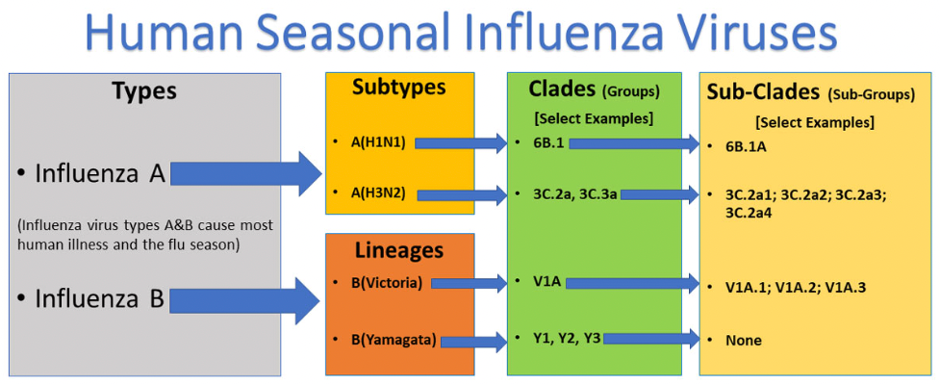
Influenza A viruses are divided into subtypes based on two proteins on the surface of the virus: hemagglutinin (H) and neuraminidase (N). There are 18 different hemagglutinin subtypes and 11 different neuraminidase subtypes (H1 through H18 and N1 through N11, respectively). While more than 130 influenza A subtype combinations have been identified in nature, primarily from wild birds, there are potentially many more influenza A subtype combinations given the propensity for virus “reassortment.” Reassortment is a process by which influenza viruses swap gene segments. Reassortment can occur when two influenza viruses infect a host at the same time and swap genetic information. Current subtypes of influenza A viruses that routinely circulate in people include A(H1N1) and A(H3N2). Influenza A subtypes can be further broken down into different genetic “clades” and “sub-clades.” See the “Influenza Viruses” graphic below for a visual depiction of these classifications.

This graphic shows the two types of influenza viruses (A and B) that cause most human illness and that are responsible for flu seasons each year. Influenza A viruses are further classified into subtypes, while influenza B viruses are further classified into two lineages: B/Yamagata and B/Victoria. Both influenza A and B viruses can be further classified into clades and sub-clades (which are sometimes called groups and sub-groups.) Note that this graphic is an example, and currently circulating influenza clades and subclades may differ from those presented here.

Influenza Vaccine Viruses

Current seasonal flu vaccines are formulated to protect against influenza viruses known to cause epidemics, including: one influenza A(H1N1) virus, one influenza A(H3N2) virus, one influenza B/Victoria lineage virus, and one influenza B/Yamagata lineage virus. Getting a flu vaccine can protect against these viruses as well as additional flu viruses that are antigenically similar to the viruses used to make the vaccine. Information about this season’s vaccine can be found at Preventing Seasonal Flu with Vaccination. Seasonal flu vaccines do not protect against influenza C or D viruses or against zoonotic (animal-origin) flu viruses that can cause human infections, such as variant or avian (bird) flu viruses. In addition, flu vaccines will NOT protect against infection and illness caused by other viruses that also can cause influenza-like symptoms. There are many other viruses besides influenza that can result in influenza-like illness (ILI) that spread during flu season.

To learn more, please visit https://www.cdc.gov/flu/about/viruses/types.htm.

Who Needs a Flu Vaccine?

March 6, 2023

WHO SHOULD GET A FLU VACCINE THIS SEASON?

Everyone 6 months and older should get a flu vaccine every season with rare exceptions. Vaccination is particularly important for people who are at higher risk of serious complications from influenza. A full listing of people at Higher Risk of Developing Flu-Related Complications is available.

Flu vaccination has important benefits. It can reduce flu illnesses, visits to doctor’s offices, and missed work and school due to flu, as well as make symptoms less severe and reduce flu-related hospitalizations and deaths.

Different flu vaccines are approved for use in different age groups.

There are many vaccine options to choose from.

The most important thing is for all people 6 months and older to get a flu vaccine every year.

If you have questions about which flu vaccine to get, talk to your doctor or other health care professional. More information is available at Who Should and Who Should NOT Get a Flu Vaccine.

WHO SHOULD NOT RECEIVE A FLU SHOT:

Different influenza (flu) vaccines are approved for use in people in different age groups. In addition, some vaccines are not recommended for certain groups of people. Factors that can determine a person’s suitability for vaccination, or vaccination with a particular vaccine, include a person’s age, health (current and past) and any allergies to flu vaccine or its components. More information is available at Who Should and Who Should NOT get a Flu Vaccine.

ARE ANY OF THE AVAILABLE FLU VACCINES RECOMMENDED OVER OTHERS?

Yes, for some people. For the 2022-2023 flu season, there are three flu vaccines that are preferentially recommended for people 65 years and older. These are Fluzone High-Dose Quadrivalent vaccineFlublok Quadrivalent recombinant  flu vaccine and Fluad Quadrivalent adjuvanted flu vaccine. This recommendation was based on a review of available studies which suggests that, in this age group, these vaccines are potentially more effective than standard dose unadjuvanted flu vaccines. There is no preferential recommendation for people younger than 65 years.

WHAT IF A PREFERENTIALLY RECOMMENDED FLU VACCINE IS NOT AVAILABLE?

If none of the three flu vaccines preferentially recommended for people 65 years and older is available at the time of administration, people in this age group should get any other age-appropriate flu vaccine instead.

SPECIAL CONSIDERATION REGARDING EGG ALLERGY

People with egg allergies can receive any licensed, recommended age-appropriate influenza (flu) vaccine (IIV4RIV4ccIIV4, or LAIV4) that is otherwise appropriate. People who have a history of severe egg allergy (those who have had any symptom other than hives after exposure to egg) should be vaccinated in a medical setting, supervised by a health care provider who is able to recognize and manage severe allergic reactions. Two completely egg-free flu vaccine options are available: Flublok Quadrivalent recombinant flu vaccine and Flucelvax Quadrivalent cell-based flu shot.

Get vaccinated before flu season starts

It takes about two weeks after vaccination for antibodies that protect against flu to develop in the body.

WHEN SHOULD I GET VACCINATED AGAINST FLU?

For most people who need only one dose of flu vaccine for the season, September and October are generally good times to be vaccinated against flu. Ideally, everyone should be vaccinated by the end of October. Additional considerations concerning the timing of vaccination for certain groups of people include:

  • Most adults, especially those 65 years and older, and pregnant people in the first or second trimester should generally not get vaccinated early (in July or August) because protection may decrease over time. However, early vaccination can be considered for any person who is unable to return at a later time to be vaccinated.
  • Some children need two doses of flu vaccine. For those children it is recommended to get the first dose as soon as vaccine is available, because the second dose needs to be given at least four weeks after the first. Vaccination during July and August also can be considered for children who need only one dose.
  • Vaccination during July and August also can be considered for people who are in the third trimester of pregnancy during those months, because this can help protect their infants for the first few months after birth (when they are too young to be vaccinated).

To learn more, please visit https://www.cdc.gov/flu/prevent/vaccinations.htm.